
That White Blister on Your Nipple at Day 3. What It Is and What to Do
Day three postpartum is often one of the most intense of all. Your milk is transitioning from colostrum to transitional milk, your hormones are shifting dramatically, you are running on very little sleep — and then you notice something: a small white blister, right on the tip of your nipple. And every time your baby latches, it is excruciating.
If this is where you are right now, you are not imagining it and you are not failing at breastfeeding. What you are likely looking at is a milk bleb one of the most common and most painful early breastfeeding challenges. This post explains what it is, what the evidence says about why it happens, and most importantly: what kind of support you actually need and how to find it in Singapore.
What is a milk bleb?
Clinical definition
Milk bleb also called a milk blister or nipple bleb
A milk bleb is a small, blister-like lesion on the surface of the nipple typically appearing as a white, yellow, or clear dot, sometimes no bigger than a pinhead. It forms when skin grows over one of the nipple pore openings, or when a small amount of thickened milk blocks the duct just beneath the surface.
The result is a blocked nipple pore and the pain can be completely disproportionate to its tiny size. Research describes it as fibrinous in nature: involving inflammation of the nipple tissue around the pore opening, not simply a skin issue on the surface. This distinction matters because it explains why surface-level remedies alone often do not resolve it completely.
Sources: PubMed (Eglash, 2020) · ABM Clinical Protocol #36, Revised 2022 · Cleveland Clinic, updated 2024
A bleb is not dangerous. It is not cancerous. It is not a sign of infection, though left unaddressed, a blocked pore can sometimes contribute to a blocked duct or, in more serious cases, mastitis. This is one reason early recognition and the right support matter.
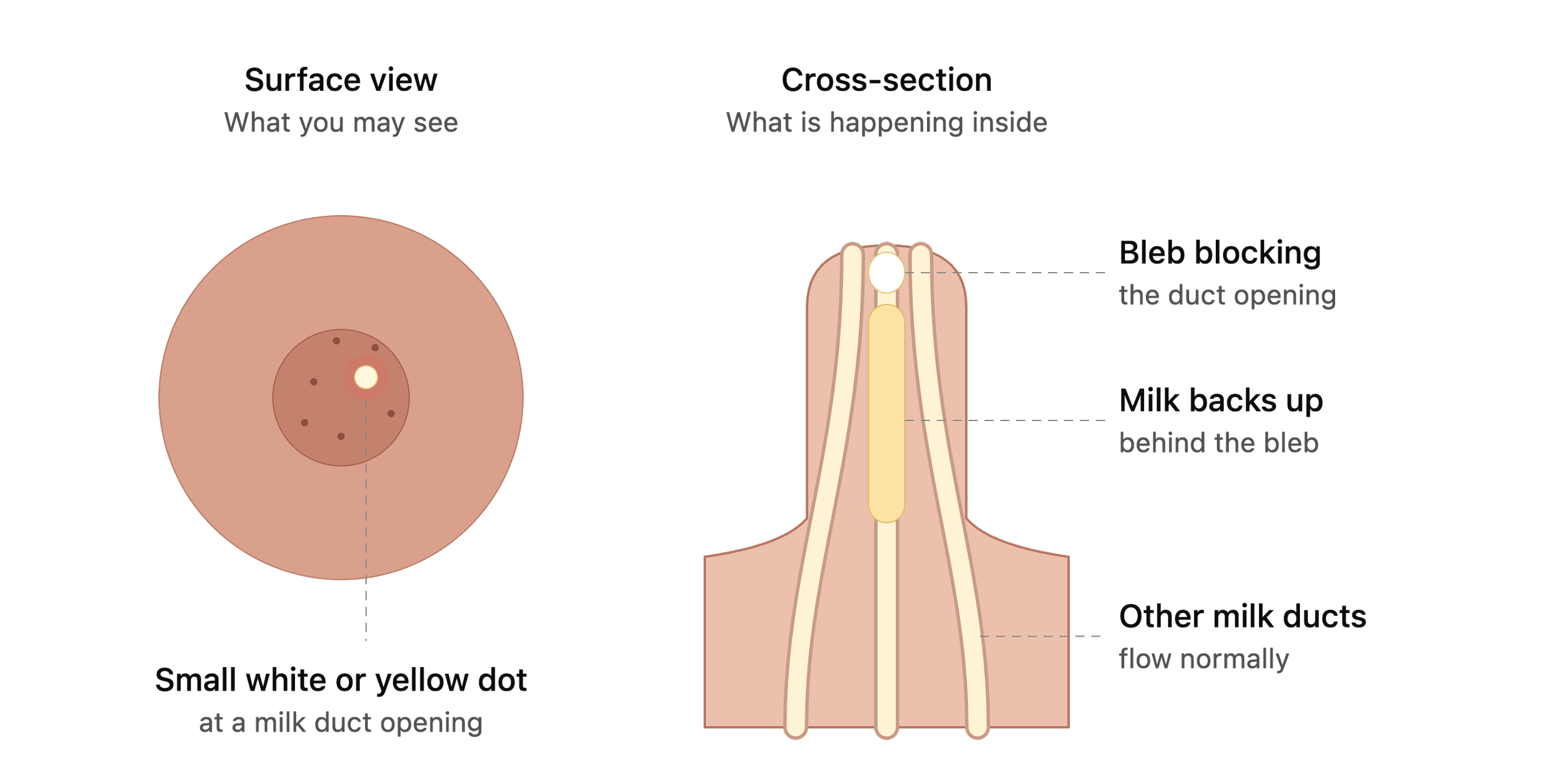
Here is a two-part illustration of a milk bleb. The left panel shows what a person might see on the surface, a small white or yellow dot at the tip of the nipple, sometimes with a little pink or tenderness around it. The right panel shows what is happening inside: the bleb sits over one duct opening, and milk backs up behind it while the other ducts keep flowing.
Why does it happen at day 3?
Day three is not a coincidence. It is the same window when your milk transitions from colostrum to transitional milk bringing a significant increase in volume when engorgement often peaks, and when the breast and everything in it is under significant pressure. It is worth naming clearly: colostrum was already milk. This transition does not mean feeding was not working before. It is simply the next stage of a continuous process. The combination of rapidly increasing volume, frequent feeding, and the mechanical pressure of a new latch creates exactly the conditions in which blebs form.
Poor or shallow latch
When a baby does not latch deeply enough, concentrated pressure on a small area of the nipple can block individual pore openings. This is one of the most commonly cited contributing factors in the clinical literature.
Engorgement and milk pressure
As milk transitions from colostrum to higher-volume transitional milk, if drainage is incomplete pressure builds in the ducts. This can push thickened milk up toward the nipple surface and block a pore from the inside.
Nipple tissue inflammation
Research suggests that blebs are primarily an inflammatory response not simply a mechanical blockage. The 2022 ABM Protocol on the mastitis spectrum places blebs within a broader framework of lactation-related inflammation.
Oversupply or hyperlactation
Women with a very abundant milk supply are more likely to experience blebs. The combination of high milk volume and ductal pressure creates conditions where the nipple pore is more easily overwhelmed.
Skin growing over a pore
Sometimes a thin layer of skin simply grows over a nipple pore unrelated to blockage from milk. This is more likely when nipple skin is dry, cracked, or healing from earlier trauma.
Flange fit (if pumping)
If you are supplementing with a pump, an incorrectly sized flange creates localised friction and pressure on specific areas of the nipple a well-documented contributing factor to bleb formation.
What the evidence shows
A 2020 perspective published in PubMed (Eglash et al.) describes nipple blebs as "blister-like fibrinous lesions that form on the surface of the nipple during lactation, likely resulting from superficial extension of underlying ductal plugging and can present concurrently with hyperlactation and mammary dysbiosis."
This is clinically important: it tells us that a bleb visible on the surface is often reflecting something happening deeper in the duct. Treating only what is visible on the skin without addressing the underlying cause is why blebs frequently recur.
What to watch for and when to act quickly
Signs that need prompt lactation support
🔴. Pain that is severe or worsening one clinical case report in the Journal of Obstetric, Gynecologic & Neonatal Nursing described the pain as "toe-curling, extreme, and piercing" that began at the start of every feed and continued throughout. If this is you, this is not something to wait out.
🔴 A hard, tender area in your breast a blocked pore can develop into a blocked duct. A firm, painful lump alongside your nipple bleb means the blockage has extended deeper and needs timely attention.
🔴 Fever, flu-like symptoms, or redness spreading across the breast these are signs of possible mastitis and require medical attention, not just lactation support. Contact your ob-gyn or GP the same day.
🟡 The bleb does not resolve within a few days some blebs clear on their own. Many do not. Research is clear that repeatedly trying to open the bleb yourself squeezing, picking, or unroofing it at home risks increasing inflammation and causing permanent scarring. Do not wait too long before seeking specialist help.
🟡 You are considering stopping breastfeeding because of the pain this is important information. It tells you that what you are experiencing is beyond the level of difficulty that should be managed without support. You deserve help before you reach that point, not after.
Why this needs lactation specialist support — not just general advice
This is where I want to be very direct with you — because I think it matters.
The internet is full of advice on milk blebs: warm soaks, olive oil, haakaa with Epsom salts, nipple massage. Some of these things may offer temporary relief. But the clinical evidence is increasingly clear that blebs are primarily an inflammatory condition not a simple blockage and that surface remedies alone often do not address the underlying cause.
A 2021 case report published in the Journal of Obstetric, Gynecologic & Neonatal Nursing followed a mother who tried every commonly recommended home remedy for weeks without resolution. It was only when a certified nurse-midwife reviewed the research and initiated a cold therapy protocol alongside a compounded nipple ointment that the bleb resolved within seven days. The lesson is not that home remedies are always wrong — it is that persistent or severe blebs benefit from clinical eyes and an evidence-based approach, not just trial and error from social media.
An IBCLC International Board Certified Lactation Consultant is the specialist trained specifically for this. They can assess your latch, identify whether there is an underlying cause driving the bleb, recommend evidence-based treatment, and where necessary refer you to a breastfeeding medicine physician or your ob-gyn for prescription treatments. In Singapore, IBCLCs are available through several breastfeeding clinics and centres and the sooner you reach out, the sooner the underlying issue can be addressed rather than compounded.
Where a doula fits — and where she walks alongside you
My role as your first layer of support from birth through breastfeeding
I want to explain where a doula like me fits into this because it is more than most people expect, and it starts long before day three.
It starts prenatally with how breastfeeding actually works. When we work together before your birth, we cover breastfeeding as part of your preparation. Not just tips, but how your body works, what to expect in those first hours, and how to set yourself up from the very beginning. Understanding that colostrum is your baby's first milk that it is working exactly as it should means you arrive at day three with confidence rather than confusion.
It continues from the moment your baby enters the world. The labour ward is where breastfeeding begins and what happens in those first hours shapes the experience that follows. As your doula, I support you through that first feed, help you understand what is being offered to you and why, and help you make informed decisions about practices that can affect your breastfeeding journey in the long run. That first skin-to-skin, that first latch, that first hour these are not small moments, and you deserve to understand what is happening in each of them.
I help you make the most of your hospital stay. Most parents leave the hospital without having fully used the support available to them because they did not know what to ask, who to ask, or when. I help you navigate that: how to call for help when you need a latching hand, what questions to ask before discharge, what to prioritise before you go home. Your hospital stay is your window of most intensive professional access it can work in your favour when you know how to use it.
In real time, at home what is normal and what is not. The postpartum period moves fast and questions do not wait for office hours. As your postpartum doula, I offer real, timely support for exactly this: what you are seeing, what it means, whether it is within the range of normal, and what to do next. A nipple blister at day three. A baby who seems unsettled after feeds. Engorgement that is not easing. These are the moments where having someone who knows you, knows your baby, and draws on evidence not just personal experience makes a genuine difference.
I support latch and positioning directly. Hands-on support with positioning and latch is part of postpartum doula care. I can observe a full feed with you, notice what is happening in real time, and work with you on adjustments that make feeding feel different sometimes immediately. I build your confidence as a parent, not your dependence on me.
And when you need deeper support, I bring in the right people. As we walk together through your postpartum, if what you are experiencing needs specialist eyes an IBCLC for a complex feeding challenge, a women's health physiotherapist, your ob-gyn. I make that introduction. Not a generic referral, but a warm, informed handover to the right practitioner for your specific situation, at the right moment. You are never navigating alone, and you are never left without a next step.
Finding IBCLC support in Singapore
If you are experiencing a nipple bleb especially one that is causing significant pain or not improving an IBCLC is the right first call. In Singapore, lactation consultants are available through several breastfeeding clinics, postnatal centres, and some hospitals. Private IBCLC home visits are also available, which can be particularly valuable in the early postpartum days when leaving the house feels like an enormous effort.
When you contact a lactation consultant, be specific about what you are seeing and feeling: describe the location of the blister, when the pain started, how your baby is latching, and whether you have noticed any changes in your breast. The more specific you are, the faster they can help you.
If you are unsure where to start, reach out to me helping you find the right specialist in Singapore is exactly the kind of navigation I am here for. Learn more about postpartum support at Papaya Wellness.
A milk bleb is small enough to miss and painful enough to make you question everything about breastfeeding. You deserve support that addresses the cause, not just the surface.
Frequently asked questions about nipple blisters and milk blebs
-
It is most likely a milk bleb also called a milk blister or nipple bleb. It is a small blister-like lesion that forms when skin grows over a nipple pore, or when thickened milk blocks a duct opening just beneath the nipple surface. It is very common in the early postpartum days, particularly around day three when milk transitions from colostrum to transitional milk and breast pressure is at its highest. It is not dangerous, but it can be intensely painful and benefits from lactation specialist assessment, especially if it is not resolving on its own.
-
The pain of a milk bleb is often completely disproportionate to its size. Clinical research describes it as involving inflammation of the nipple tissue around the blocked pore meaning it is not simply a skin issue but a localised inflammatory response. Every time your baby latches and creates suction against that point, it activates the inflamed tissue. The pain can be sharp, piercing, and may radiate deeper into the breast. Some mothers describe it as among the most intense pain of their early breastfeeding experience.
-
The clinical guidance is consistent on this: no. Attempting to open, squeeze, or unroof a bleb at home increases the risk of infection, mastitis, and in repeated cases, permanent scarring of the nipple tissue. A case series published in Breastfeeding Medicine documented patients who developed surface scars from repeated at-home attempts to open their blebs and in some cases the underlying bleb persisted even after the scar was removed. If the bleb needs to be opened, this should be done by a qualified healthcare provider using a sterile needle in a clinical setting.
-
A bleb that is not causing significant pain may sometimes resolve on its own within a few days to a couple of weeks. However, blebs that are painful, affecting milk flow, or recurring tend not to resolve without addressing the underlying cause whether that is latch, positioning, oversupply, or inflammation. The clinical literature is clear that treating only the surface blister without identifying and addressing the root cause leads to recurrence. Early IBCLC support leads to better and faster resolution than waiting it out alone.
-
A milk bleb is a localised blockage at the nipple pore painful but a surface-level issue. Mastitis is a broader breast inflammation, typically involving a larger area of the breast, and is often accompanied by systemic symptoms: fever, flu-like aching, redness spreading across the breast. A bleb left unaddressed can contribute to a blocked duct, which can progress to mastitis which is one reason prompt IBCLC support matters. If you have fever alongside breast pain and redness, contact your ob-gyn or GP the same day, as mastitis may require antibiotic treatment.
-
A doula's role in breastfeeding is supportive and informational not clinical. A postpartum doula can help you understand what you are seeing, explain what the evidence says, and guide you to the right specialist promptly. In my own practice, breastfeeding preparation is part of prenatal sessions so families I work with arrive at the early postpartum days already knowing what common challenges look like and who to call. During postpartum visits I sometimes spot things in real time patterns in positioning or latch that have not yet been flagged. I do not treat, but I inform and navigate. The IBCLC is the specialist; my role is to make sure you reach them without delay and with the right information in hand.
Navigating the early days of breastfeeding in Singapore?
Whether you are preparing before your baby arrives or already in the thick of it a free 30-minute clarity call is a space to talk through what you are experiencing, what support is available, and how I can help you find the right care.