
"Big Baby" in Pregnancy. What Does It Really Mean?
"Your baby is measuring big." Those five words can send a pregnant person into a spiral of worry that lasts weeks. I've sat with many clients in Singapore who've heard this at a scan and came away frightened, confused, or already being nudged towards interventions. So let's talk about what "big baby" actually means, how accurate those predictions really are, and what questions you should be asking your care provider.
Because here's the truth: most babies labelled "big" are born healthy, at a perfectly normal weight. And the scan that predicted it may have had a margin of error of up to 15–20%.
Recently, a pregnant client shared how heartbroken she felt after her doctor told her that her baby was “big.” This isn’t the first time I’ve heard this from parents. The phrase “big baby” can spark feelings of confusion and worry, especially as scans become more frequent late in pregnancy. But what does “big” actually mean, how accurate is this diagnosis, and what choices do you have especially in Singapore’s diverse maternity care landscape?
As a birth and postpartum doula at Papaya Wellness Singapore I’m supporting families across Singapore’s public and private hospitals, I regularly support parents who are told their baby is “big” especially among diverse, multicultural communities in Singapore. Whether you’re giving birth at KK Women’s and Children’s Hospital (KKH), NUH, or a private maternity clinic, understanding how your baby’s growth is measured can make a world of difference in how you navigate pregnancy scans and birth planning.
During my second pregnancy, I managed gestational diabetes and had regular ultrasounds showing my baby's tummy circumference at the upper range. Scan after scan flagged size. My OB was wonderfully supportive and never pushed for interventions based on measurements alone and I'm grateful for that, because I know not everyone has that experience.
I gave birth exactly on my due date — which is its own small miracle, since only about 5% of babies arrive on their actual due date. And my "big baby"? A healthy 3.2 kg — right in the average range, even for a gestational diabetes mama. The scans were not the whole story. They never are.
I share this not to dismiss scan findings — they matter — but to remind you that a number on a screen is the beginning of a conversation, not the end of one.
What Really Is a “Big Baby”?
A baby is medically classified as “large for gestational age” (LGA) if their weight is above the 90th percentile for their gestational age, or as “macrosomic” if expected birth weight exceeds 4 to 4.5 kg (8.8 to 9.9 lbs). Yet the majority of babies almost 9 out of 10 will be born between 2.5 to 4.5 kg. So, “big” is very much a relative term
How and When Is “Big Baby” Diagnosed in Singapore?
In Singapore, most big baby concerns begin with third-trimester ultrasound scans. While fundal height measurements checking the distance from the pubic bone to the uterus can signal size concerns, this method is not routinely used in most private clinics. It may occasionally be performed in public hospitals or later in pregnancy.
Instead, doctors rely almost exclusively on ultrasound scans to compare abdominal circumference, femur length, and estimated fetal weight to standard growth charts. The choice of which chart to use can make a significant difference for families in Singapore’s multicultural setting.
Which Fetal Growth Charts Are Used in Singapore?
Singapore’s hospitals and clinics use a variety of fetal growth charts:
Local population charts:
KK Women’s and Children’s Hospital and Singapore General Hospital use charts built from thousands of Singaporean babies, reflecting Chinese, Malay, and Indian growth patterns.
These Asia-specific charts show most local babies have similar growth and, compared with global charts, often slow down in growth after 37 weeks.
International standards:
Some care providers (especially private) use INTERGROWTH-21st or Fenton charts, which are accepted globally but may over- or underclassify “big” and “small” babies in Asian populations.
Ethnic/multiethnic charts:
As Singapore’s birthing families increasingly include mixed ethnicities and expats, multiethnic and customized charts are in use or in development to better match a child’s genetic background.
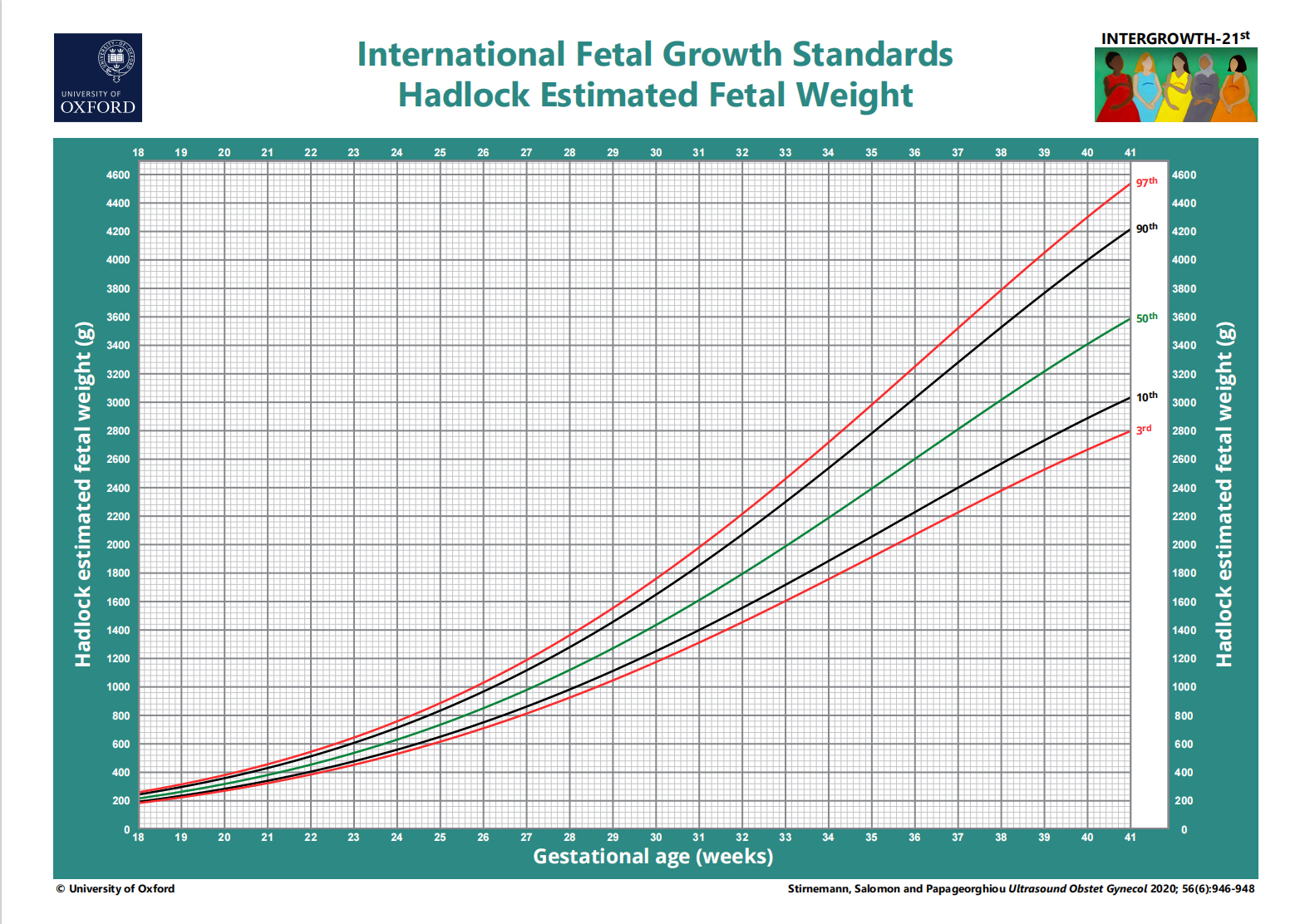
Research has found that up to 6.7% of babies were classified differently as small, appropriate, or large simply depending on whether INTERGROWTH-21st or Fenton charts were used. The chart choice is not a minor detail.
Why Does Chart Choice Matter?
The choice of growth chart directly impacts how your baby’s size is interpreted:
International charts may not account for natural differences among Singapore’s ethnic groups or multicultural couples, mislabeling healthy babies as “too big” or “too small”.
Locally validated charts help ensure assessment matches your baby’s actual growth pattern, leading to more nuanced care and fewer unnecessary interventions.
Gestational Diabetes and Baby Size
Gestational diabetes raises the risk of higher birthweight, but with modern prenatal management, most babies especially with blood sugar control are born within healthy ranges. Supportive care means less alarm over scan findings.
“Managing blood sugar levels can help to prevent potential pregnancy complications.”
What Parents Can Do. Questions to ask your care provider
When told “your baby is big,” don’t settle for vague answers. Instead, ask:
Which reference chart are you using for my pregnancy?
What percentile does my baby fall on this chart?
Is the chart designed for my ethnic background or family mix?
Are scan findings being interpreted with Singapore-specific data?
How accurate are late-pregnancy ultrasound predictions in your clinic?
Focusing on percentiles is far more meaningful than hearing a broad statement like “your baby is big.” Percentiles show exactly how your baby’s measurements compare to others at the same gestational age to a relevant population—but the significance depends on which chart is being used too. This can help you avoid unnecessary anxiety and make better decisions about your care and birth preferences.
In Singapore’s multicultural birthing community, the “big baby” label is best understood within the context of accurate, locally relevant growth charts. Ask your provider for details, focus on percentiles, and know that scan predictions are only part of the story. Most “big” babies, just like those called “average” are born healthy. Trust your care team, seek second opinions when uncertain, and let knowledge be your guide.
People also ask about big baby diagnoses in Singapore
-
Late-pregnancy ultrasound estimates can have a margin of error of 15–20%, meaning a baby predicted to weigh 4.2 kg could arrive anywhere from around 3.4 kg to 5 kg. Predictions become less accurate the closer you are to your due date.
-
Not necessarily. Many babies predicted to be large are born vaginally without complications. The decision depends on multiple factors your pelvis, your baby's position, your overall health, and your provider's assessment. A big baby estimate alone is not an automatic indication for caesarean.
-
Most babies in Singapore are born between 2.5 and 4.5 kg. Singapore-specific growth charts from KKH and SGH reflect the natural growth patterns of Chinese, Malay, and Indian babies, which can differ from international averages.